
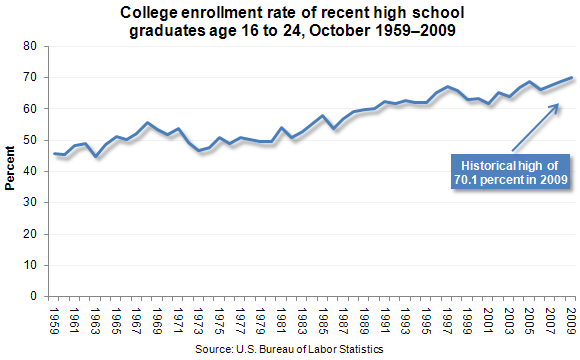
Like no other mass marketed product in the US, the price of college tuition has increased at a near linear rate. From a young age, college is hammered home as the “golden ticket”: the ticket to a better life, a house and the entry way to adult hood.

While no one disputes that the college is a transformative experience – many are now concerned the ROI (return on investment) of college is declining of attending top schools (See a representative article here). However, the data shows that these claims do not hold up. Recently, payscale.com published ROI’s for the top schools in the country and the top prestigious schools still have a positive return that can beat the market and other schools.

Of course, the above data requires both employers and students to buy into the filtering system college offers. It, at the least, demonstrates that top employers are not hiring only for the hard skills learned at school – they are paying for you to grow as a person. Furthermore, they are using the college experience as a filtering mechanism to make sure you are a socialized, person who can work and has the ability to learn. Employers do use GPAs, but really are more focused on what school you attended vs. how much you know of a certain subject. The pressure to have abnormally high GPAs for all graduates has resulted in the metric becoming inflated and unreliable. With all the different majors, classes and professors, these metrics are very tough to use across schools and candidates.

But as any finance, economist or political scientist will tell you – tuition prices cannot increase forever. Operating from the assumption that this space will eventually be disrupted, we can see some interesting steps in this direction.
First, the Wall Street Journal ranked undergraduate colleges by polling recruiters (vs the USNews, which uses a mix of survey data and hard metrics). Turns out, most recruiters’ value the education and candidates at big state schools vs the liberal arts POV of creating a more all around, holistic educational experience.

Second is the dramatic increase in online and offline enrollment in for-profit colleges. (Yes, this is driven by government grants and financing, but in general are a cheaper alternative to many private schools). But are these really the alternative they claim to be? As good as the courses and curriculum are, it is hard to judge 1) what students learned in their courses and 2) The value of these degrees in the marketplace.

The non-profit response has been interesting. There are more online options as well as free content around the web. The economic value of taking a course online, or in school is high only if you can demonstrate that knowledge to someone who will pay for implementing that knowledge. It is precisely for this reason that many colleges are now offering their course materials for free (yes, free) online. The real value in top universities is the degree and the social experience, not the fact that you attended classes and learned the material, which is similar across many schools.


So where does that leave us looking into the next decade? There is no doubt there will be some disaggregation between the high price of tuition and the actual ROI of that education - but will the value of the knowledge acquired be disaggregated from the value of the college experience itself? In other words, how will an employer be able to tell the difference in the knowledge acquired between two graduates? One solution is to standardize this portion of the college process, allowing greater transparency between the student (who will want to show their skills), colleges (ranking how well they achieve results compared to peers) and employers (standardizing what knowledge is important and how to measure it).


No comments:
Post a Comment